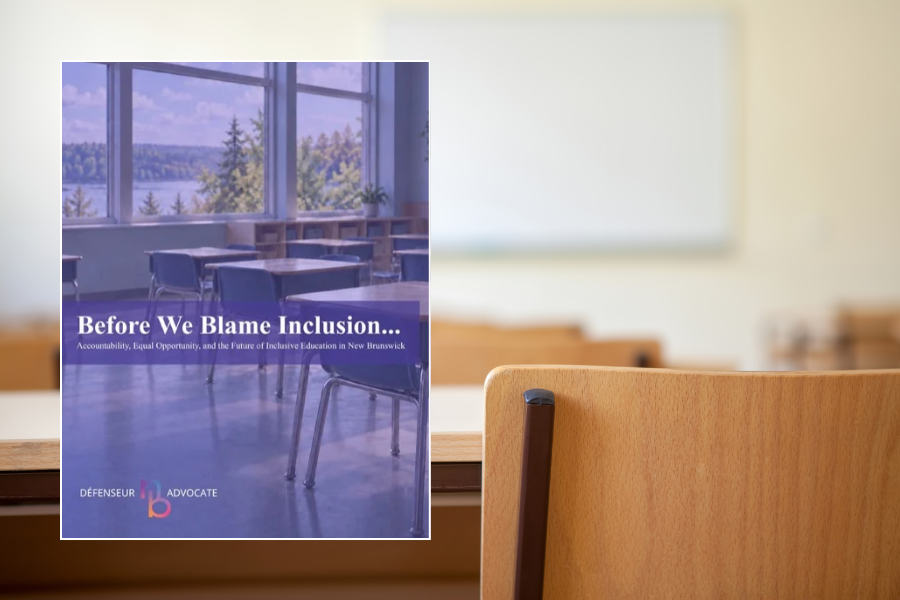
FREDERICTON – New Brunswick Advocate’s report, Before We Blame Inclusion, presents an opportunity to strengthen implementation, accountability and meaningful participation for students with disabilities.
The report reinforces concerns that students with disabilities and their families continue to experience barriers to accessing timely supports, coordinated services and meaningful participation in their neighbourhood schools and classrooms.
Importantly, the report also challenges a growing tendency to blame inclusive education, and sometimes the students it is intended to serve, for pressures being experienced in classrooms. Those pressures are real, but inclusion cannot become the scapegoat for broader structural challenges in our education system.
For Inclusion NB, the path forward is not another review or redefinition of Policy 322. This policy has already undergone two previous reviews. New Brunswick has an established commitment to inclusive education. The opportunity now is to translate that commitment into consistent practice across the education system, ensuring that the policy is fully implemented, adequately resourced, and supported by clear accountability measures.
“Policy 322 provides an important foundation for inclusive education in New Brunswick. We have an opportunity to build on that foundation and address the gaps between what we have committed to and what students and families are experiencing every day. This is about moving beyond good intentions and ensuring that every student has the supports, opportunities and sense of belonging they deserve,” said Andrea Randon, Co-Interim Executive Director, Government & Partner Relations.
The Advocate’s report highlights several areas requiring attention, including delays between the identification of a student’s needs and access to coordinated supports, the use of partial school days, restraint and seclusion practices, and barriers to equitable access to and continued participation in French immersion, including the impact unequal access to French Immersion can have on classroom composition and the concentration of students requiring additional supports in English Prime Classrooms.
Inclusion NB supports stability in French Immersion programming and is not calling for another change to the current entry points. At the same time, maintaining those entry points cannot mean overlooking the longstanding concerns about equitable access to French Immersion or the impact that patterns of enrolment can have on classroom composition. The focus should be on ensuring that students with a disability and additional learning needs have equitable opportunities to enter and remain in French immersion, while also examining and addressing the concentration of need and supports within English Prime classrooms.
These are not simply policy challenges. Nor are they evidence that inclusive education is failing. They reflect longstanding implementation and system design challenges that must be addressed directly. When classrooms lack adequate staffing, intervention capacity or access to specialized supports, the resulting pressure can too easily be attributed to inclusion itself. The answer is not to exclude students with a disability. It is to address the conditions that are preventing inclusion from working as intended.
Inclusion NB sees an opportunity for the provincial government, educators, families, students with disabilities and community organizations to work together on a clear, funded and time-bound implementation plan.
“No student should lose access to their education or be isolated because the systems around them have not been adequately equipped to support inclusion. We know what many of the solutions are. What is needed now is the commitment, capacity and accountability to put those solutions into practice. That means supporting educators, investing in our schools and ensuring families are meaningful partners in decisions that affect their children,” said Randon.
The Advocate’s report also provides an opportunity to shift the conversation from debating the definition of inclusion to examining how we can make it real for students in our schools. It is about whether they are welcomed, supported, engaged, and able to participate meaningfully in their classrooms and all other aspects of school life.
Inclusion NB encourages the provincial government to use the report as a catalyst for action: publicly respond to its recommendations, establish measurable implementation commitments, identify clear departmental responsibilities and timelines, and create meaningful opportunities for students with disabilities, families, educators and disability organizations to help monitor progress.
New Brunswick has an opportunity to demonstrate what is possible when inclusive education is treated not only as a policy commitment, but as a shared responsibility, a human right guaranteed under the United Nations Convention on the Rights of Persons with Disabilities and a priority in practice.
-30-
Media Contact:
Ariel Dillon
Inclusion NB
adillon@inclusionnb.ca