
Vanessa Assis and Hillary Nguyen with the City of Fredericton shared their journey on becoming a more inclusive employer at our Art of Giving event held on October 15.
October is Disability Employment Awareness Month and Hillary has some insights on how she has prepared her workplace and teammates to ensure their engagement. She also has some practical tips for successfully welcoming the City’s newest employees to the team.
“When I first came on board, the City had already allocated funding to explore what our path forward could look like.
An early activity was coming up with a name that would speak to what we were trying to accomplish and engage those that would be involved.
I didn’t just want an acronym that sounded nice. I wanted something that really captured the heart of what we were trying to do. So, I started by listing the outcomes we cared about most: empowerment, opportunity, inclusion, and professional growth. From there, I asked myself: what’s one word that brings all of that together? That’s when EQUIP came to me.
EQUIP stands for Empowering Qualified Underrepresented Individuals in Professions.
It works on two levels; we’re equipping underrepresented individuals with the tools and support they need to succeed, and we’re equipping our organization to be stronger, more inclusive, and more reflective of our community.
That’s why the name felt so meaningful — it’s a reminder of both the people we’re serving and the culture we’re building.
Our core values—Integrity, Respect, Teamwork, Engagement, Work Ethic, and Professionalism—commit us to create a workplace where everyone feels safe, included, and supported.
EQUIP builds directly on these values. By working with community partners and creating opportunities for underrepresented individuals, we are not only supporting our employees but also reflecting the diversity of our community. This is about more than filling positions—it’s about living our values in action: treating people with equity and dignity, building trust, and recognizing the strengths and talents that everyone brings.
Embedding EQUIP into our workplace shows that inclusion isn’t just a policy; it’s part of how we work, how we support each other, and how we contribute to the success of the City.
Once we had our intention solidified, we worked with our Office of Community Inclusion, HR and other hiring departments. Inclusion NB provided early training for supervisors and managers, mentors, our HR team and some of the other team members who might possibly work with the EQUIP employees.
We created surveys for department heads to identify tasks that could be reassigned, conducted accessibility reviews, and shared research on best practices. Then, we began internal communication and engagement sessions to build awareness and support across departments.
It’s also important to recognize the speed at which this program was developed. The budget was approved in November 2024, based on a September submission, I started my job at the City in February 2025 and within a few months until August we had finalized, posted, hired, and onboarded employees.
Achieving all of this in less than a year shows the commitment of our team and our partners to making EQUIP a reality. There’s no ‘one size fits all’ solution, as accommodations need to be flexible.
What made the biggest difference were one-on-one conversations and collaborative brainstorming sessions, which helped build trust and made supervisors feel like partners in the process. And through accessibility reviews, we discovered that small, often simple changes could have a big impact.
We provided in the pre-hiring stage:
- Clear definition of the role and responsibilities on the job posting
- Offered support to accommodate any needs during the interviews
After hiring
- Welcome email a week before their first day making the connection with their supervisor and aligning their schedule
- Introduction to team members
- Orientation day was designed specifically for them:
- printed material was sent in advance
- less slides on the presentation, less text, more pictures, clear and focused messages
- provided an organization chart with their names in the structure, so they could see they are part of a team
- Introduced them to their peer mentor
- Provided a list of tasks
- Provided on-the-job training
- Regular check-ins
What’s next?
- Professional development training
It’s been a few weeks since we welcomed Jenna, Sunny, Marcus, and Christopher. We onboarded these team members successfully by supporting them not only on their first day at work, but also continuously.
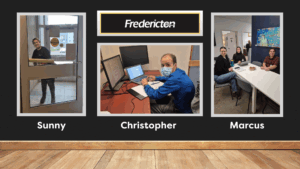
The initial feedback from the team has been positive, but it’s also been very honest. People appreciate the focus on inclusion, but they’ve also pointed out we need to be intentional about making it work in practice.
Sometimes employees get sick, departments become short-staffed, or plans fall through at the last minute — so we’ve learned the importance of having backup tasks ready and communicating changes right away.
Team members have also said that clear, direct communication makes the biggest difference. Everyone has their own style of learning and working, so sitting down with employees one-on-one and asking specific, pointed questions has been far more effective than leaving things open-ended. That feedback has helped us adjust our approach and support people in a way that feels practical and responsive.
So, what’s next? I would like to see us hiring more people with disabilities in 2026, more departments engaged, and successful hirings all over Fredericton.
We want to share our heartfelt thanks to Inclusion NB, Jobs Unlimited, Neil Squire Society, Ability NB, Capital Region Mental Health & Addiction Association, John Howard Society, Vision Loss Rehabilitation Canada, and the NB Deaf and Hard of Hearing Society. Your guidance, generosity, and time during the development and planning of this program—and your ongoing support for our employees—have meant so much.
We’re also grateful to our senior leadership team and our hiring departments—Communications, Recreation & Tourism, Building & Fleet Services, Legal Services, Real Estate, and Planning—for believing in this initiative and working alongside us to make it possible.
And finally, a very special thank-you to our mentors—Erica, Pam, Marley, and Vicki. Your kindness, encouragement, and patience have been such a steady source of support for our employees, and for us as we learn and grow together.”