
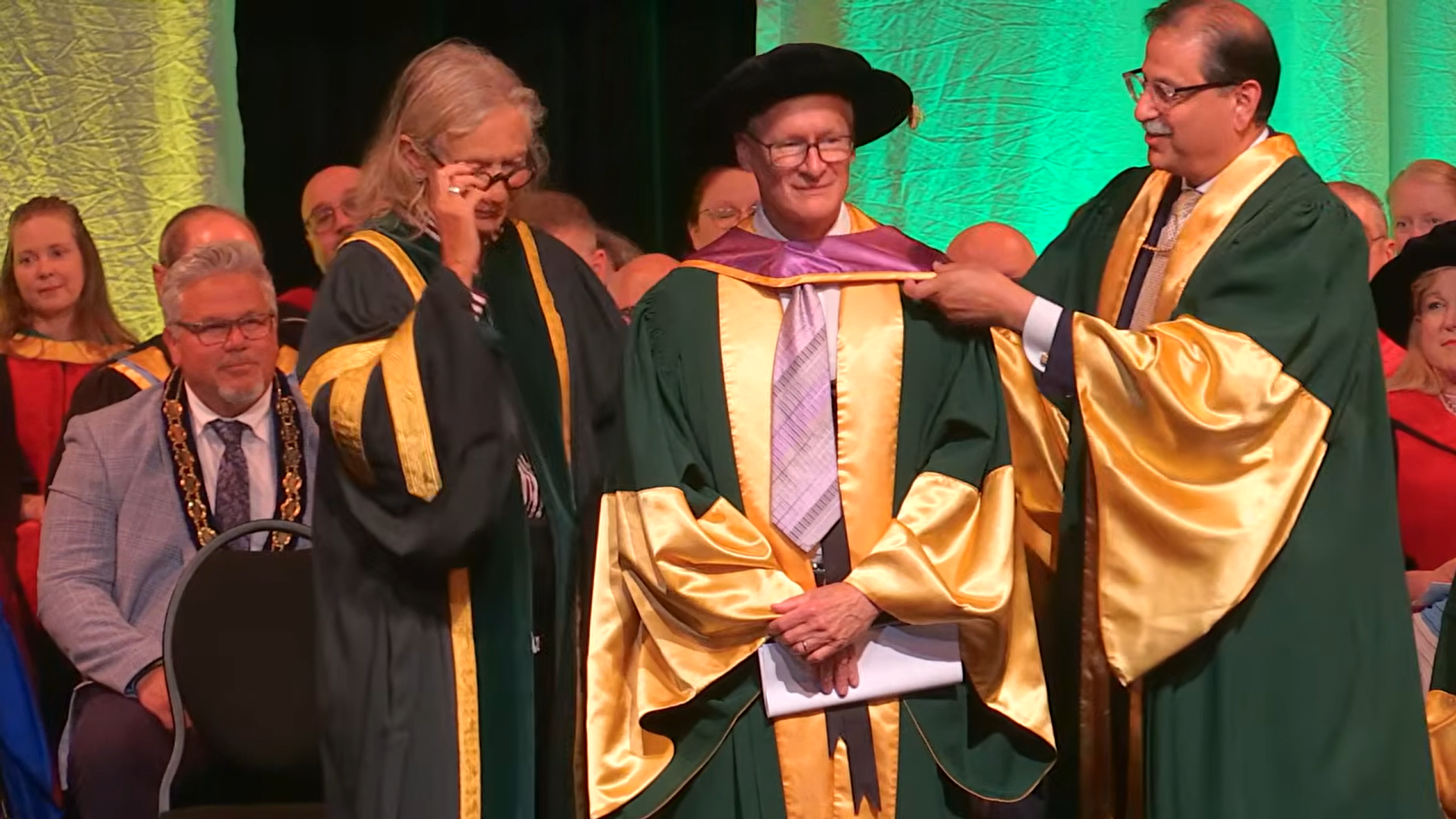
On July 3, 2026, our friend and colleague, Ken Pike received an Honourary degree from St. Thomas University. As we reflect on the 40th anniversary of inclusive education in New Brunswick, this recognition is especially meaningful. Ken’s lifelong leadership has played a critical role in shaping the inclusive education system we know today, not only in our province, but across Canada.
Here is an excerpt from the address he gave at the University’s convocation:
I have had the privilege of spending almost four decades working to promote the rights, dignity and inclusion of people with a disability. I would like share the lessons I’ve learned from having a career as an inclusion and human rights advocate.
This is rooted in having the incredible gift of getting to know and work with people who taught me important lessons or truths. These were first and foremost people who struggled to be heard and recognized and who were sometimes not treated very well. Yet, they were often some of the most resilient people that I have ever met.
- Attitude is critical in everything we do. I learned quickly that one of the biggest barriers that people with a disability often faced was the attitude of other people – people who did not see their potential or believed that their disability limited their rights and opportunities. For those of you who are pursuing careers in education, attitude is critical for a successful inclusive education system. Our schools are places of wonderful diversity. While training and resources are important, an attitude of “we can and we will” is often a key difference between a school that it truly inclusive and one that hopes to be.
- Take the time to get to know the people you will be engaging with in your work and life.
People’s lives can sometimes be complex – seek first and foremost to understand and be with people. This means taking the time to get to know people for who they really are. It’s easy in professions to get stuck on the things that may be wrong with people. When we seek to know and understand people, then we can start to build a relationship, and that relationship can lead to trust and authentic support. - Affirm people and their accomplishments. People are reminded of the things they have done wrong or perhaps can’t do. We see this play out in the lives of people with a disability and others. So, be an affirmer. Look for and find the good in people, encourage them, and find ways to acknowledge their accomplishments.
- Demonstrate kindness in your interactions with others – even if they may be challenging you. Our world today seems to be becoming less kind. As an advocate, I’ve learned that I will encounter people that I disagree with – and sometimes strongly. I’ve also learned that it is not worth it to treat people disrespectfully or unkindly. And it does not cost me a thing to maintain an attitude of kindness. If fact, it keeps the door open to perhaps change someone’s mind or actions.
- Human rights matter for everyone. I always found it amazing that human rights were sometimes seen as optional. This has often been the case for people with a disability. There is a reason we have international treaties recognizing and affirming the rights of children, indigenous persons and people with disabilities. Those who work in service systems or education have obligations to understand, defend and enhance these rights.
- Change can be real, but also difficult and sometimes fragile. We have been fortunate to live in a place where positive change is possible and injustice can be named and addressed. It is incumbent on all of us to be vanguards of progress and to address the wrongs that still exist. We can do this in the careers we choose and in our homes and communities.
- In your lives and careers, follow your heart and do what you love and love what you do. I have been blessed to have a life and career that gives me purpose and an opportunity to serve others. I hope that from this day you experience the same blessings and find the work that brings you joy and fulfillment.
- Lastly, – please remember always that real intelligence is virtue, kindness, compassion, gratitude, and human connection – truly not artificial at all.
Thank you, good luck, and many blessings to you all!